Saturday, 19 May 2018

The Homecoming


May marks a veritable glut of public holidays in France. There’s Worker’s Day on 1 May, Armistice Day on 8 May, Ascension on the 10th and the Pentecost holiday, every third Monday of May. If one of these should fall in the middle of the week (as is the case this year for Worker’s Day) employers may give their staff an additional non-working day before or after, at their discretion.

It’s thus the ideal time to take an extended break in Blighty. I’d hardly need to touch my annual leave. It’s long overdue. I avoided the dreaded mal du pays for several months. It took my mum’s second visit earlier in spring and a hopeless crush on my unofficial French tutor Bernard, to make me realise how isolated I’ve started to feel in Strasbourg. (A former globetrotting friend reckons it usually kicks in around the 6-month mark). It’s not as much mal du pays as mal des proches. I’m not so far removed from hectic London living to begin to miss it. What I do miss is my networks; having history with people.

No history, no baggage. One astute friend observes during my UK visit. True. But I also like the idea of being round those who’ve seen me at my best and worst and stuck around. It takes time to build that goodwill. I am depressingly aware of how superficial my social life is in Strasbourg. I have a handful of acquaintances only one of which I could call a friend in the classic sense. She also has a life to lead. I can’t allow myself to become too clingy. Before my UK trip-the first since I relocated to Alsace-I feel the ache more acutely. It’s taking all my energy to resist an instinct to latch onto my few Connaissances Strasbourgeoises. I feel low, tearful and anxious. This is exacerbated the closer I come to the trip. The accommodation I’ve sorted with a friend is suddenly up in the air. A visit to the Midlands to see a friend after a nearly two year hiatus falls through…

In the end, it all resolves itself. My UK visit, now concentrated in London, is just the soul tonic that I need to revive my joie de vivre. My friend puts me up with her mum until things settle down and I can stay with her. She offers a somewhat chaotic but extremely warm welcome. My schedule is completely full with meet-ups, church visits, hair appointments and helping a friend’s campaign to become a Labour Councillor in a solidly Blue ward in Camden.   I traverse the City almost everyday meeting acquaintances old and new and spend most evenings eating with mum. I meet up with most of whom I hoped to see. There's something about not taking it for granted we're in the same country that helps us make the most of the time. I have several enriching conversations (one too many of which make reference to a viral news story involving a certain Mr West). I manage to squeeze in a little French practice at a Francophone event. 

After a cold and wet start, the skies clear and temperatures climb to Mediterranean heights for a substantial part of the holiday. Not even the UK media's devious attempts to twist the Labour Party's decent local election result into a defeat can wholly dampen my mood.

The 10 days naturally fly by. I am relieved to experience no drama on my return via Basel airport, despite my slightly over-the-limit cabin luggage.

Since the train strikes are still in full swing in France and there are no coaches back to Strasbourg available at a reasonable time, I make use of the carpool service recommended by my office-mate Claudia.  I am collected from Basel by the highly personable Olivier. He arrives early. We make it back to Strasbourg long before the ETA. He's inordinately excited to hear of my Nigerian connection.

I worked in Plateau state for years!

You're probably more Nigerian than me then. I quip with no malice.

Olivier speaks some pidgin to boot (again, more than I can claim).  We spend the duration of the drive talking about wanderlust and multilingualism. It's one of those unexpectedly reassuring moments; where the milk of human kindness flows freely and I'm reminded of God's Providence.

Back in Strasbourg, I have one day of respite before returning to work thanks to Ascension Day. I decide to go back on a Friday. Just to be contrary. And also to make a head-start on my emails (which still run into triple figures, despite the numerous public holidays). By the afternoon my inbox doesn’t have a single unopened message. The department is quiet, many colleagues taking the opportunity to have an extra long weekend, including my supervisor Sophie and Claudia. I like the calm. Not too many questions about my time off. A few comments on my change of hairstyle but not too much.

Sunday, 29 April 2018

One of the Girls

 One Friday night in mid-April, I accompany a group of volunteers from my church who support sexually-exploited women in the Strasbourg area. It’s a cause in which I’ve wanted to be involved for many years. Back in the UK I provided voluntary administrative assistance for charity Beyond the Streets. I was, however precluded from offering more practical support to their sister organisation, Door of Hope as it requires a long-term commitment of at least 18 months. That’s hard in a city of transit like London. I’ve changed jobs twice, moved house three times and relocated country in the past two years alone.

Thus, I see it as something of a God-send to discover that EPIS has a dedicated street team. A month prior to my first outing I meet up with Sabrina, one of the team leaders. She’s a remarkably equanimous petite brunette of Spanish descent. We spend time getting acquainted. My French is not on top form that evening but Sabrina is patient. She wants to know my motivation for joining the team. I tell her of my voluntary experience back in GB. She explains that most of the women the team come across are either of West African or Eastern European origin. Pimps and madams use various methods to exert control over the women. Those from Nigeria have often been forced to participate in elaborate juju ceremonies where they invoke curses on themselves should they ever seek to escape. The families of those from the former Soviet bloc are threatened. 

At the end of our rendez-vous, Sabrina kindly offers to drop me off home on the way back to her place in the sticks. We pass the European institutions. I mention I live and work in the vicinity. She informs me that much of the team’s outreach is based not too far from there. When the international dignitaries come into town for a big conference, business for the Girls’ exponentially booms. It’s hardly surprising but it still makes my blood boil. It's yet one more example of the abuse of power. The so-called defenders’ of human rights willingly participate in the denigration of another’s.

Some weeks after meeting with Sabrina, it's the evening of my first outing with the team. I swiftly become aware that I am not at all well-prepared. I’m wearing masochistically impractical block heels. I could have done with an afternoon siesta too. It’s going to be a long night. Still, I have my Christian-feminist zeal to carry me through. I hope.

The group goes out several nights per month, mainly on a Friday. The official meeting time is 8pm. Sabrina arrives early to welcome us. She’s expecting a particularly good turn out. We squeeze into one of the back offices. There are kettles, flasks and sachets of hot drinks everywhere. I am to discover that this isn’t merely to keep the team warm. We’ll be offering beverages to those we encounter during the course of the night. The rest of the group takes an hour to trickle in. Every one who arrives insists on the cheek-to-cheek bisou. I promptly warn them that kissing perfect strangers is far too intimate for my anglicised customs. I abstain as much as possible. I’m also suddenly feeling self-conscious about my French.

(courtesy of The Praying Woman)

Joseph, a shy young Chemistry student, makes awkward conversation with me. At one stage, he claims some African languages sound ‘weird’. I correct him as patiently as I can manage.

That’s subjective. ‘Weirdness’ does not exist in this context.

Bless him. He’s making an effort.

We are eventually joined by one of the other team-leaders, Luc. It is thanks to his Sunday announcement back in January that I first find out that the group exists. In real life, he's open, amicable and much younger than I recall.

When all the group is gathered, Luc leads us in a time of prayer in the Upper Room. The team affectionately refer to the women as The Girls or Princesses. I have some difficulty keeping up with the speed of conversation and don’t feel confident to pray in French. Thankfully, nobody asks. Yet.

We divide into smaller groups. Two or three will reach out to the Girls, the others will focus on rough-sleepers in town. I will be joining Sabrina and Joseph. I comment on how small the teams are. Sabrina explains that any bigger than three might be too overwhelming for the women.

The routine is simple enough. We offer hot drinks, an opportunity for the women to share whatever is on their mind and suggest prayer if they want it. The group also has contacts with those who work in social services, should the Girls want to be signposted.

Sabrina drives us out to an area known as the Citadel. All three of us take it in turns to pray before we set out. I alternate between English and tentative French. 

The night's activities will expose me to a side of Strasbourg with which I was not previously familiar. 

Before long we meet a couple of Romanians. Gabriela recognises Sabrina, welcoming her warmly and eager for some tea.  Her companion, Regina, is polite but reticent. She drops back as Gabriela discusses her mother’s health problems with Sabrina. We pray for her recovery and Gabriela’s children. On cue, a potential client calls the two away. Before leaving they mention other Girls have gathered up the road.

We walk for a while before we see any more. Sabrina says it’s a quiet night, considering the relatively mild weather. After some time we come across a trio of Albanians. The youngest has neither French nor English. I feel terrified for her. Without either of these languages she has even less control over what she does with clients. She is initially reluctant to engage but quietly sidles up when she sees us talking to her acquaintances, Belinda and Marina. They have just celebrated Orthodox Easter. 

Sabrina enquires about doctrinal similarities. Marina and Belinda converse enthusiastically, sipping cups of coffee in between. We ask the name of their younger friend (Anna). The discussion oddly turns to 90s American films. Then American Pie. Then sex. Joseph in his well-intentioned but gauche manner tries to explain biblical teachings about lovemaking. I’m pretty sure the women are already well-versed in it. We pray for Belinda's mother (health issues again) and move on.

Further on in our travels, we meet Kate. She waits alone at a deserted bus stop. Her greeting is guarded, despite having met Sabrina on at least one previous occasion. She mentions to Kate that I am also of West African descent. Kate switches to English. We bond over our shared heritage and similar physiology. She welcomes our prayers. I lead in English. She has four children back Home for whom she’s trying to provide. She wants a way out of the life. Any job would do.

We’re only half way through a two-hour + shift and the night is already taking its toll. My shoes are biting. The temperature's dropping. Emotionally I am finding it hard to hold it together. I fear for the safety of the Girls’, especially those on their own. The reality of their existence hits me like a blast. I’m struggling with anger and resentment towards the johns.

Near the end of the shift we bump into strident Albanian beauty, Lisa. Something about her indomitable spirit makes me adore this youthful mother-of-two in an instant. All three of us stand slack-jawed (even the stoic Sabrina) as Lisa recounts in rapid French the horrific health issues she’s experienced lately. She’s suffering from complications following a botched termination. She went to see a doctor in Germany after falling pregnant when a client’s condom split. Part of the foetus was accidentally left behind. She has bled profusely for over a month. 

Lisa isn't apprehensive about sharing the gruesome details. There’s not a hint of self-pity in her tone. No welling up. Nothing but raw indignation. The trip to Germany, procedure and medication has set her back several hundred euros, not to mention the impact on business. She finds out too late that this doctor has a reputation for mishaps. Several minutes into her distressing monologue, Lisa’s phone goes off. I’m desperate to pray with her. She excuses herself, taking the call at a distance. We hang around. She’s not coming back anytime soon. We make do with praying for her as we head back to Sabrina’s car.

En route, a couple of Girls call us over. Laura is another force of nature; assertive and quick as a whip. In the brief time we spend in her company, she displays cognisance of four languages. She intermittently communicates with Sabrina in Spanish. She castigates a potential client who drives by without stopping, gesticulating fiercely as he whizzes past.

He’s watching porno in his car. What’s the bloody point?


Laura is with a younger blonde. They drink very sugary coffee and catch us up on their news. She asks after Luc. It’s not the first time one of the ladies has inquired of him. Laura is reluctant for us to talk about personal matters in front of her protegée. Next time, she says. She asks us to pray for her in our own time.


We take our leave. We’re late. The others will be waiting for us back at church. As we walk towards Sabrina’s car another young blonde emerges from the bushes, running after us in impossibly high stilettos. We stop. This is why we came. Our timetable is determined by the Girls' needs. Any slither of comfort, hope or practical assistance we can offer them, by the grace of God, is well worth going off piste.

I am introduced for the umpteenth time that night as the rookie. I don’t mind. I intend to become as well-acquainted with the Girls as the other members of the team. That is, until they are able to finally get out of the life.

On the drive back to church Sabrina spots some of the princesses whom we didn’t see earlier. She regrets not having had a chance to interact with them. I reassure her that we spoke to whomever we were supposed to that night.

As upsetting as the encounters have been, I can't have possibly taken on their full implication. I'd go mad. 

Later that week, I will think of the men I know. Whether they could be found amongst the clientele of these, or any other women involved in the sex trade. There must be a happy medium between misandrous cynicism and being naive enough to believe it couldn't happen just because they're of my acquaintance. Only recently, a friend based in the UK confesses that he frequented brothels during a difficult period.

Back at EPIS HQ, the groups reunite for a debrief.  We pray and disperse. It’s around 1am. Sabrina drops Joseph off at his student quarters. On the way back to mine, I confide in my level-headed interlocutor. I feel conflicted. I am torn between despising men who pay for sex and being true to my Christian values not to condemn them.  It's not for me to cast stones.  Reducing another human being to an object of momentary pleasure, merely perpetuating the system that exploits them, is but yet another manifestation of human brokenness from which I am not exempt. Thank God for Jesus.

Saturday, 21 April 2018

Cultural Excursions


There haven’t been many things I’ve missed about the UK since moving to Strasbourg. Loved ones. The NHS. British Aldi and Lidl. I can add the London theatre scene to that list. 

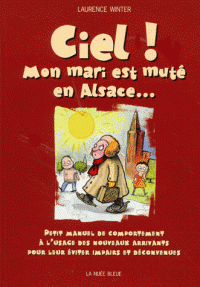
I’ve not availed myself of the French theatre tradition either. That is until now. The Bienvenue á Strasbourg association have finally organised an event I can attend. It’s a production of the satirical two-hander ‘Ciel, Mon Mari est muté en Alsace !’ or (Heavens, My Husband has been Transferred to Alsace!’), staged at the Munsterhof, a stone’s throw from the Cathedral. It’s told from the perspective of a sophisticated Parisian wife highly reluctant to head East, based on the many stereotypes about the hybrid Franco-German culture, odd social mores and bad weather (Please. I grew up in Britain).

The audience is filled with a fair amount of Alsatians, making sure the region isn’t done a disservice. One native spends the night apoplectic with mirth. Her male companion teasingly nudges her after one of several fits of hysteria. I don’t understand all the jokes nor, frustratingly, a lot of the dialogue during the poignant Second World War historical overview. I do learn that the Marx Bros and Django Reinhardt all have Alsatian roots. In the end, it’s not a bad first encounter with French theatre. The male actor’s absurdist turns are sufficiently entertaining and any language practice is useful.

The play finishes earlier than expected. Great. It’s a school night anyway. As I’m heading towards the exit, I’m lured into an adjacent room by the smell of grub. I vaguely recall mention of an after-show reception. Ah. Vol-au-vents. How I’ve missed thee. This is doing my post-Lent austere intentions no good. I capitulate somewhat, squirrelling away snacks with the intention of freezing them and indulging on a ‘treat day’.

(courtesy of L'Alsace)

Looking around, I suddenly feel maudlin. There are contexts in the UK in which I’d be confident speaking to strangers. In Strasbourg, I’m too self-conscious about my imperfect French. I leave the venue, self-chastising and feeling guilty about my hors-d’oeuvres haul. I seize an opportunity to divest myself of them when I spot a couple sleeping rough.

Walking from the venue to my bus stop, the fresh Spring evening air lifts my mood before I know it. Strasbourg beguiles me with its beauty despite myself; even at night.

That weekend I’m back at the Munsterhof to attend the award ceremony for the annual Anglophone short story competition for Strasbourg residents. The invitation arrives in my nom-de-plume inbox, contained in the same email informing me that my entry was not successful. Not surprisingly, I don’t have much interest at first in attending the ceremony. If my story wasn’t good enough for your poxy competition, leave me be. Besides. I don’t want to be reminded of my own inadequacy when hearing the shortlisted entries. Half are written by authors for which English is not their first language. Oh yes and there’s a junior under-18 category too, to twist the knife into my mediocrity.

Then again, it’s an excuse to dress up, go out and meet those with a common interest. I might also learn a thing or two from the winning entries.

Considering the prize is now in its 10th year, it’s a curiously informal affair; almost chaotic. I’m over-dressed -as always- judging by most of the casual apparel (where is the sense of occasion?). I sit next to a woman whose handbag is wide-open. Upwards of 100 euros cash is visible through a transparent wallet. I wonder what sort of economic security can make a person so lax with their belongings. There’s a fair share of guests milling around. A few walk out mid-ceremony.

The main event is not the soul-destroying experience I have feared. Yes, the all female finalists from the under-18 categories are depressingly accomplished. (It does make me wonder how ‘non-native’ English has been defined. This year’s Junior Laureate, Ferre Wuchner, is young and proficient enough to be classified as a first language speaker. My question is never answered). However, most of the ‘native’ level shortlist are reassuringly hoary-haired. There’s time yet for me to hone the craft.


I’m also heartened by the encouragement and advice from co-host and one of the three competition judges, Michael Wright. A successful journalist and author in his own right, he admits to never having won a writing contest. Also comforting are his empathetic observations about artistic insecurities and how the inner critic’s voice only becomes louder with age. The solution he says, is simply to persevere. The man is All Wright. Even if he has written for the Daily Telegraph. To my shame, this latent prejudice precludes me from thanking him in person after the ceremony. Once again, I’m not feeling up to the required post-show socialising. I’m knackered from the night before, having returned in the early hours of the morning. (Nothing untoward, of course).

I head straight to my bus stop, strolling through the bustling sun-drenched streets. My heart skips to see more evidence of blossoms in full bloom. Despite being flanked by a seasonal melancholy these past couple of weeks, I can’t begrudge the advent of Spring and all it promises.

The following day I’ve arranged to attend a photography exhibition at La Chambre with recently-made acquaintance Muriel. It showcases the work of Stephen Shames, focusing on his documentation of the Black Panther movement during the 1960s and 70s. I originally invite my unofficial French tutor Bernard but he flakes without warning.

A few minutes before we meet, Muriel sends me a text asking if I mind if the boyfriend tags along. Damn it. I don’t like the idea of being the third-wheel in this couple-based trinome but I can hardly say no at the last minute. I will myself to be gracious.

La Chambre is smaller than I anticipate. Cosy. We are shown around by an enthusiastic and attractive young brunette who speaks a mile a minute. Miraculously, I can follow most of it. Muriel and I look on in envy at the full Afros, carried regally by African-Americans with amazing bone structures. 

The exhibition isn’t limited to Shames’ work with the Black Panthers, coming right up to date with the Black Lives Matter movement. The photographer has spent several decades documenting the inhabitants of deprived areas in his native New York; mostly in monochrome. 

Muriel and I marvel at how Shames earned the trust of his subjects. Some portraits are incredibly intimate. Naked adolescents scrub down in the communal showers of an adult prison. A shirtless Huey Newton stands in the middle of his living room, following his release from prison. He’s holding a Bob Dylan LP, sporting a rakish (maybe even triumphant) grin. A young man clutches his girlfriend in what looks like perturbed sleep. A smirking biker yanks down his lover’s top, exposing her bare breast. She also smiles, complicit in her degradation. There’s an image from the early 90s of the open-casket funeral of a 12-year old slain by bullets, his family understandably ravaged by grief.

(c) Stephen Shames
Afterwards all three of us head to Place d’Austerlitz for a natter. Muriel and boyfriend Gustav have plans to catch a film later. We chat about Strasbourg vs. London life, my work at the Organisation, pop culture, Gustav’s Slavic/Germanic roots and Afro hair maintenance. Gustav is bemusedly fascinated by the mysteries of the latter. He makes one or two comments that verge on the casually racist. Or perhaps I'm just being sensitive.

He and Muriel bicker affectionately like an elderly couple but I don’t feel excluded. Once in a while these things turn out better than expected.

This week's soundtrack:

'Black on Blonde' + 'The Anchorman Mixtape' by K-Os

Tuesday, 10 April 2018

Another Long Weekend

Baden-Baden Town Centre

Late March welcomes daylight saving hours. Time seems to speed up even more than usual. Easter is also a little on the earlier side this year.

I originally planned to go to  Blighty for a week or so. However, on her last visit mum suggests, off the cuff, spending the holiday with me in Strasbourg. I’m resistant at first but then warm to the idea. It would give us a chance to explore the region together. We fancy a few days in Frankfurt. Alas, by the time her leave is approved, travel prices have skyrocketed.

Maybe it’s a blessing in disguise. France’s national rail company SNCF have scheduled a protracted strike that will put paid to a lot of regional travel by train in the short term.

Mum’s flight from Gatwick is scheduled to arrive on Easter Saturday. I spend Good Friday getting my house in order, literally. Come the afternoon, following an unsuccessful attempt to connect with sis via Skype, I feel my solitude more acutely than usual. It can’t help having been indoors all day. I don’t step out until the evening, to attend a special Vendredi Saint service near the town centre. The church I regularly attend doesn’t have any plans for Passion Week beyond the normal Easter Sunday service.

The ambiance at St Paul’s is intimate. A Passion concert is being set up in the main hall so we meet in the back. The room is illuminated by candlelight. The youthful female vicar’s message takes the form of a monologue from the perspective of Mary Magdalene, punctuated by what I assume are traditional French Easter-related hymns. A young Francophone African woman with a melodious voice and a tooth-sized gap between her front teeth attempts to teach us an acappella addition to the canon. I fumble through the Lord’s prayer. I don't know it off heart in French and oblivious to it being reproduced on the free pamphlet that was handed to me on entry.

The service ends with Holy Communion and a caveat from “Mary Magdalene” that the rumours about her being the Messiah’s main squeeze are merely prurient untruths. I head to the concert in the main hall. I change my mind when I realise that, rather than being free entry as I believed, the tickets will set me back nearly 20 euros.

Having finished my cleaning a day early, I’m a relatively free agent on Saturday before mum's arrival. I just have to put the finishing touches to my mixed-meat tagine. After the mini-disaster that was mum’s last trip, both of us hope her second French excursion will be far more promising. It wouldn’t take much. Just an absence of drama would suffice.

I’ve asked mum ahead of time to leave her interior decorating impulses behind in London. I don’t want her fussing, just to relax. And no general life tips either, unless solicited.

I’ve requested a few bits and bobs but not much. I still have a healthy amount remaining from the last stash mum brought. Nevertheless, true to her extremely generous nature, mum stuffs her suitcase with unexpected household items (many of which she ends up using herself, transforming my flat from clean to spotless). She has the excess luggage fee to show for it. As well as more chocolate and treats than would be kind to my waistline, she has smuggled in some of her very delicious Good Friday fish and yam speciality and various traditional South-East Nigerian ingredients. Thanks to mum’s provisions, I end up cooking only twice during her nearly one-week stay.

She remarks that I’ve lost weight.

I knew it.

Her loaded silences and side-long glances during her January visit gave away more than I wanted to know. I credit Lenten abstinence. It often does the trick.

Mum’s trip thus far has been mercifully strife-free. Having collected her at the coach station and unpacked her London-bought booty, we settle down to a relaxing meal and Netflix-related entertainment. For the rest of the week, Roald Dahl’s Tales of the Unexpected will be our viewing of choice after I mention it in a burst of bemused nostalgia.

Robertsau Forest
Sunday morning, mum and I find some strategic seating at the back of EPIS church-auditorium so I can translate the service for her. Afterwards, we are politely informed by a friendly couple that the church provides contemporaneous translations via headphones in a variety of languages, including English.

I catch up with Mon Ange Lyonnais, Jeanne, after service. At last, I have the chance to introduce her to mum. Easter Sunday weather is miserable. Thus, it’s straight home to indulge in high-sucrose grub and for me to get the meal ready. Mum can’t stand lamb so I’m preparing beef as a compromise. Following a recommendation by Jeanne, I’m experimenting with a tartiflette recipe. The final result is crunchier than hoped but mum’s hungry enough to finish it off.

To compensate for our temporarily abandoned Frankfurt plans, I’ve planned a series of day trips. We stay local on Easter Monday, taking a long stroll down to my local forest. The heavens are kind to us. The grim weather forecast that had me rearranging my itinerary never properly materialises. Some days are quite clement.

The forest is dense even in its still-bare post-winter state. We walk for a good half hour before we come across a proper seating area. During our ramble, we spy a young stag bounding along majestically, stalked by an exhausted but resolute hound.  Couples and families come and go in waves. At some point, I spot a dead ringer for Gautier; the former Navy officer who was very keen for me to come round to his place for dinner. We make eye-contact whilst I try and ascertain if it’s him. He (or his doppelganger) is in the company of a female friend. I decide it’s best not to interrupt.


The following day has been set aside for Baden-Baden; Germany’s equivalent of the English town of Bath. Everyone, from Sophie my supervisor to Yotis my landlord, has recommended it. SNCF’s industrial action doesn’t impede our plans as I’d feared (Vive Le Syndicalisme ! Rest assured, I still have love for the Unions). Our trains are operated by German companies. At the interchange in the middle-of-nowhere Appenweier, some little fraulines are inordinately fascinated with me and mum. They run away screaming with delirious laughter if I look in their direction. We play along. When I stick out my tongue, one of them promptly reports me to her mother, whose bare cranium is decorated with elaborate tattoos.

The weather is once again on our side. Unfortunately, I have not been my usual conscientious self and done some research. I assumed Baden-Baden was a remote Forest based outpost, as my mind’s eye has interpreted descriptions by my acquaintances.

The town is much bigger than I anticipate. I reluctantly ask for directions at the station on mum’s repeated behest. Thanks to the not-quite-accurate instructions we end up lost. We are told to descend at Leopoldplatz. Except our bus doesn’t stop there. I suggest we get off at the picturesque area surrounding the LA8 Museum. It looks close enough to civilisation. Mum insists we stay on board. We literally take the scenic route, covering the outer edges of the Black Forest. The bus does a loop without stopping. On our way back into town, some inspectors get on board. 

Sigh. Not again.

My German is virtually non-existent. Mum has even less. We try to explain that we were lost and didn’t realise the driver was going straight back into town. They demand to see our passports. Thankfully, I have the presence of mind that morning to suggest we carry them. The inspectors seem perversely impressed that we are British citizens.

One of them, stereotypically Aryan-looking, has limited English. None of them speak French. The sole female inspector asks other passengers if they know any English. A woman approaches with enough to convey (with some difficulty) our predicament. Mum is talking over me. I irritably demand that she stops. The situation is confusing enough as it is. It’s not the last time mum and I will have words about her well-intentioned but not-entirely-helpful interpretation efforts.

The intervention of the passerby is a God-send of sorts. She signals us to hush. We have the choice of paying for a return journey or a 60 euro fine each. No contest really.

The rest of the trip is reassuringly incident free. Baden-Baden is as pretty as I’ve been told. We arrive too late for the ridiculously brief opening hours of the Roman Baths Museum but there’s enough around town to keep us occupied for the whole afternoon.

On the penultimate day of mum’s sojourn, we pop to Kehl.  She is unimpressed by the bargains I’ve talked up, compared to what’s available in London. I suppose Strasbourg life has relativised my idea of a good buy. Your standard deal in the UK is comparatively bargain-basement here.

Mum whiles away hours looking for homeware.  Our plans for a leisurely crepe lunch in Strasbourg fall to the wayside.

I’ve warned her that my flat doesn’t need sprucing. I’m a simple woman of modest tastes. Against my wishes, she spends most of her own holiday cash on decorative flourishes. I tell her off, torn between sounding like an ingrate, wanting my autonomy respected and not wishing to be an inadvertent burden on her purse.

But I love spoiling people. It’s just the way I am…


We make it to the end of mum’s break with no disasters and fun memories to compensate somewhat for the bitter taste of her first visit. Having safely seen her off at the coach station, I receive a text a few hours later. Mum’s arrived in good time for check-in at Basel airport. All is well.


Friday, 30 March 2018

Sisterly Solidarity


Strasbourg is doing its fair bit to champion female empowerment in March. Beyond just acknowledging the international day of women on the 8th, there have been a number of commemorative events around town throughout the month. A few of those have been done in collaboration with THRO.


One evening, straight after work, I attend a panel discussion with six dynamic female academics. Each speaker gives an historical overview of the struggle for women to obtain the vote in their respective European countries of origin or domicile. Just as I arrive, an enthusiastic bespectacled woman approaches me, gabbling in French.

Are you Cecile Kyenge?

She is referring to the sole brown face on the panel. Kyenge is a Congolese MEP who became the first minister of African descent in her adopted Italy. I am surprisingly irate. Aside from a similarity in complexion, Kyenge and I look nothing alike. She has at least 15 years on me. She wears a cropped black afro. I have long-ish kinky twists with burgundy highlights. Nothing would link us besides our shared ethnicity.

There are other black women in Strasbourg, you know. I retort. I’m surprised I have the presence of mind. In French for that matter.

Oh no. That’s not what I meant. It’s just we’re expecting her…

Micro-aggressive cretin. I silently fume whilst locating a seat in the auditorium.

Inadvertent racism notwithstanding, it’s something of an honour to be associated with Cecile, even if unintentionally. She is an amazingly resilient and intelligent woman. Unlike the rest of the panel, her 10 minutes + is dedicated to her own experience with (dis)enfranchisement and entry into politics. An ophthalmologist by training, Kyenge’s political journey started rather late. She didn’t vote until the age of 30, having arrived in Italy from DRC at 18 years old and having to wait several years to obtain citizenship and the right to join the electorate. Much like her trailblazing British counterpart Diane Abbott, Kyenge has been subjected to eye-watering levels of abuse because of her gender and ethnicity. She has spent several years in and out of court bringing high profile offenders to justice and won a significant victory last year.

I’m duly inspired by the event (and grateful for the language practice). 

On a roll, I head to another feminism-related lunchtime book launch held at The Organisation the following day featuring one of the speakers from the previous night’s conference.

I’ve been impressed by the breadth of topics covered thus far. The conversations have been nuanced and not as polarising as I’d expected. I wear the feminist label with more boldness than I did in my younger years. However, I don’t subscribe unreservedly to what some feminists might call red line ideologies. I am wholly aware my views on certain issues would be considered too conservative for them.

Meanwhile, back in the office relations with Claudia have vastly improved. We’re conversing a lot more. Our confrontation a few weeks back looks increasingly like a blessing in disguise. I admit to having misjudged how to handle the stalemate beforehand. I should have tried earlier to extend the olive branch.

We speak about the politically unstable situation in her native Italy. I tell her of my admiration Cecile. Cosmopolitan Claudia is all too aware of -and embarrassed by-the treatment to which Kyenge was subjected.

Cecile Kyenge (courtesy of Libération)
The following week, one of my managers Lucia, calls me aside for a one-to-one. Another department big wig, Marie-Anne, will also be in attendance. This doesn’t sound good. I have very little to do with Marie-Anne in my day-to-day operations. At first, I try unsuccessfully not to fret. I go through the possibilities in my mind. I have tried to be the consummate professional. Will I be told off for using the photocopier for personal reasons? Sometimes listening to music whilst I work? I email mum and sis. I pray throughout the morning. By the time the mid-afternoon appointment rolls around, by the grace of God, I’ve attained some level of serenity.

Marie-Anne does most of the talking. There’s a somewhat formal preamble before she gets down to business. A customer service rep from the travel agency used by THRO has made unflattering comments about me. It proceeds a conversation the afternoon before when I called to discuss a flight related cock-up that has occurred involving two consultants only recently hired by the department. We speak for a few moments in French but I decide to switch to English to avoid any misunderstanding of content or tone. At some point the rep, Sebastien, becomes aggressive and unprofessional. I tell him in as collected but firm manner as I can muster that this behaviour is not acceptable. I acknowledge he’s under a lot of pressure, what with various travel-related industrial action making his life harder, but I also have a job to do. I confirm the details of the conversation by email, to which Sebastien responds in terse grammatically imperfect English. My supervisor Sophie is in copy. She later comments on his abrasiveness.

After Marie-Anne’s long introduction I have an opportunity to give my side of events. I do so dutifully and calmly, all the while shocked at the irony that Sebastien should complain about me.

Marie-Anne and Lucia ask some tendentious questions about my overall job satisfaction.

It’s just we noticed a few weeks ago you and Claudia closed the office door. You were talking for an awfully long time. Your body language suggested it was heated. We’ve never had someone in our team so fiery...’

Here we go.

That’s patently untrue. I’ve seen and heard enough to the contrary.

My efforts to self-efface as much as possible have not worked. My subtle attempts to avoid perpetuating any stereotypes regarding my gender and ethnicity have apparently been for naught. People are going to draw their conclusions regardless. Perhaps my paranoia about being too visible on the radar is justified.

I try to remain equanimous. I dodge leading questions about my relationship with Claudia.

We’re just very expressive people, I parry, We had some misunderstandings to clear up…

I’m not about to incriminate my colleague nor dredge up what is now ancient history.

The half an hour intervention feels almost twice as long. Marie-Anne concludes with yet another imprecation that we all get along. Sebastian was just stressed. We can’t afford to have bad relations with the Travel Agency since we depend on their services…

The department is comprised of nice people, she insists. I must feel at ease. I shouldn’t hesitate to ask questions.

I’m a little shell-shocked. On the plus side, it’s been great French practice.


Shortly afterwards, I discreetly tell Claudia about what has just transpired. She’s very surprised that Sebastien complained (as is Sophie, I'm later to discover). She’s heard far worse exchanges between THRO employees and the Travel Agency. I ask Claudia what she thought of my interaction with Sebastien. She was present at the time.

I’ve lived in the UK. She tactfully replies, I understand the British sense of "firm but fair". But it’s not always taken that way here.

She proffers a few more personal examples of culturally-related misunderstandings. I make a mental note of how to side-step them.

I become more and more convinced Sebastien took particular umbrage with my assertiveness because of my gender. If I were a man, he either wouldn’t have spoken to me in that manner or wouldn’t have thought it worthy of note that I objected.

Social attitudes will evidently take longer to change than a-month-per-year of awareness-raising can achieve.

Thursday, 15 March 2018

A [Wander]lust for Life

The Streets of Selestat, Alsace
I figure I might as well take advantage of Strasbourg’s strategic location. Whilst I’m here. It’s often called the Capital of Europe, sandwiched between the rest of France, Germany, Switzerland and Luxembourg. There’s also the vast region of Alsace on my doorstep to discover.

Having acquainted myself with the charms of Colmar over the Christmas period, the even closer Selestat is next on my list. It’s barely a town. More like a sizeable village. I avoid doing these daytime excursions on the weekend for obvious reasons. However, I appear to have chosen an especially uneventful Monday to become familiarised with Strasbourg’s neighbour. I comment to a local cafe proprietor on how deserted it is. She agrees. It’s never very busy but even then...today is particularly slow.

One of Selestat’s main claims to fame, the Humanist library, is closed for renovation. I walk around the ghostly quiet streets. Thanks to the quaint (as always) layout and the surrounding Vosges mountains, there’s enough pretty scenery to hold my attention. I’m tickled by the sight of more toy-town style houses from centuries passed. I have overestimated how long it would take to 'discover' Selestat. I have a lot of time to kill before my return train. As is my custom, I while away some of the afternoon in orthodox church buildings. Heavenly voices beckon me into St George’s, singing multi-part harmony cantons, acappella . Unable to locate from whence this celestial chorus emanates, I like to believe they are practising in the vestry. Alas, it’s a mere recording. The serene atmosphere is inviting, nonetheless. I find a corner to focus my overly-occupied mind. Suddenly, a burst of sunlight streams through a parallel stain glass window. I’m caught in its path. After an afternoon of almost solidly grey skies, it’s the first let-up.

My first trip to Luxembourg isn’t so propitious on the weather front. I’d have thought an early Spring foray would ensure at least a couple of days of sunlight. But much of Europe is still recovering from the so-called Beast from the East. Having rushed to the station with 10 minutes to spare before departure, I’m greeted with the news of a 40 minute delay to my journey. Adverse weather of course. I text my AirBnb hostess. I’ve rented a room in the suburbs, half an hour from Luxembourg City. She warns me of the slippery conditions. Thank God, I had the presence of mind to pack my wellies.

Arsenal Sainte-Barbe, Selestat

The non-committal metallic sky brings with it a malaise. I’ve booked a long weekend to see a country that could probably be visited in a day. When my supervisor, Sophie asks my weekend plans and I mention Lux she replies, with her ever-cheerful diplomacy. Cool. It’s small…

My unofficial French tutor, Bernard is visibly less enthusiastic. He falls silent at the mention of Luxembourg, pulling a face before he can stop himself. C'est petit... I venture; almost apologetic.

Oui, c'est ca, he replies in his austere baritone, with a firm nod.

Well, I’m here now. Cold weather or not. It’s not all bad. In the light of day, from the train window, the Luxembourgeois landscape looks like it’s covered in frosted icing. That will have all but vanished by the next day, when arctic-lite temperatures give way to milder climes.

A friend back in London recommends I check out the cliffs (and the night life but it’s not going to happen when it's Baltic outside). I suppose he means the precipices on which much of the main City is built. The bocks are stunning, in a morbid sort of way. Breathtaking even, quite literally. My mild vertigo kicks in at the sight of the sheer drop, particularly where the barriers are (to my mind) not high enough to protect my precious, soft body from the rocky surfaces below. The hazardous weather conditions make me more nervous still. I notice other tourists descending the steep steps built into the rock faces or walking across exposed bridges. It gives me the shivers.

I find tranquillity once again, in sacred spaces; this time in the capacious crypt of the Notre Dame Cathedral. It's enchanting, in a surprisingly modern way. The unsettlingly aged depiction of Christ on a stained glass window is out of place, however.


A View from the Bridge: Overlooking the Luxembourg bocks ,
one snowy weekend


I cover much of what I wanted to see within a few hours. I catch my train back to Rodange with less than two minutes to spare. It’s early evening when I arrive back at the AirBnb. My ever-smiling Greek host Delphina will soon retire, alongside her beautiful young son Jonas.

I’m a little undecided about the rest of my itinerary for the next couple of days. I could go to neighbouring village Echternach but being a Sunday, the trains are so infrequent. I’m hoping to make it back to Luxembourg that afternoon to see a film. In the end, I dilly-dally during the morning, chatting to sis on Skype which throws any half-baked plans into complete disarray.

Echternach it is then. A few tourists dot the deserted Sunday streets. I amble towards the Benedictine Abbey, stopping off at a cafe frequented by Portuguese customers and with Lusophone staff. It’s my second of many a Portuguese encounter on the trip. (The first was an unwanted overture by a Guinean (Bissau) in the impressively cosmopolitan Luxembourg City). I’ve been so busy worrying about French, I’ve almost completely neglected my rudimentary Portuguese. The few sentences I’d practically memorised to perfection come out more falteringly.

The Abbey’s devotion to St Willibrord is a little too idolatrous for me. On exiting, I take a moment to admire the arborous hills that flank the village. It must be quite a sight in the summer or during the copper-golden autumns.

At some point, Bernard’s cryptic admonition comes back to haunt me. It makes sense in hindsight. I didn’t need a long weekend to explore Luxembourg. It takes less time by train from Strasbourg than Paris. I could have done it on a day off; an overnight stay at most. I would have saved the accommodation fees.

You live and learn.

Travel soundtracks:

Respite in Milan: Part III

(c) Mikita Lo My last full day in Milan is set aside for a day trip to Lake Como, as recommended by Melissa and everybody else in the region...